Phoenix Grandmother Cancels Third Back Surgery After Trying Spine Surgeon's 15-Minute At-Home Method
The retired teacher had been told her only remaining option was another spinal fusion. Then her daughter found a controversial home device built by a a top US-trained orthopedic surgeon, and everything changed.
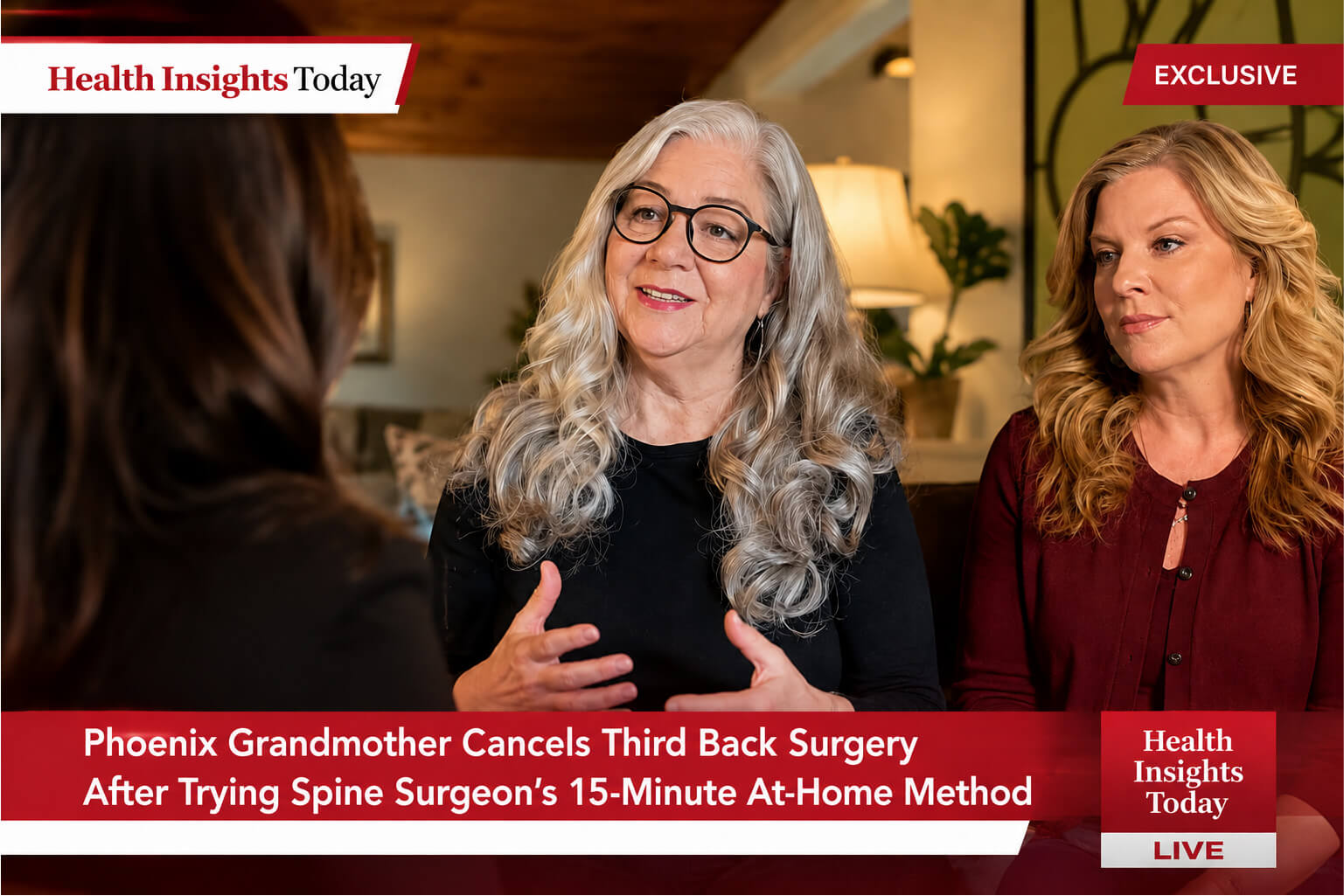
Margaret L., 67, at her home in Phoenix. She was scheduled for her third spinal surgery in November. She cancelled it after three weeks with the device.
PHOENIX, AZ. Margaret L. had been counting down the days to her third back surgery the way most people count down to a vacation.
Not with excitement.
With dread. With the slow, hollow resignation of a woman who had been told, more than once, that this was just what the rest of her life was going to look like.
A retired elementary school teacher and grandmother of four, Margaret had lived with chronic lower back pain for nearly seventeen years.
By her own count, she had seen eleven different doctors. Undergone two surgeries. Received more than thirty steroid injections. And tried, in her words, "every cushion, every brace, every pillow, every cream, every patch, every supplement, every mattress, every chair, every machine on QVC."
By last summer, she could no longer sit through a meal at her own dining room table.
"My grandkids would come over for Easter, for birthdays, and I'd have to keep getting up. Or I'd just go lie down in the bedroom and they'd come back to take turns visiting me," she told us.
"That was when it started to break me. When the kids stopped expecting Grandma at the table."
In October of last year, her surgeon recommended a third procedure. This time, a more invasive lumbar fusion of three vertebrae.
The estimate, including post-op rehabilitation, came to just under $74,000. Insurance was projected to cover roughly 60%.
"I cried when they sent the estimate," Margaret said. "Not because of the money. Because I knew, somewhere inside, that the second surgery hadn't really fixed anything. Why would the third?"
She wasn't wrong to worry.
According to a major review published in The Spine Journal, repeat spinal surgeries fail to provide meaningful relief in roughly 40% of cases. The failure rate climbs with each subsequent procedure.
A condition called adjacent segment disease, in which the disc next to a fused vertebra breaks down under the increased load, affects an estimated 25% of fusion patients within ten years.
Then her daughter Jessica, an accountant in San Diego, found something on her phone late one night.
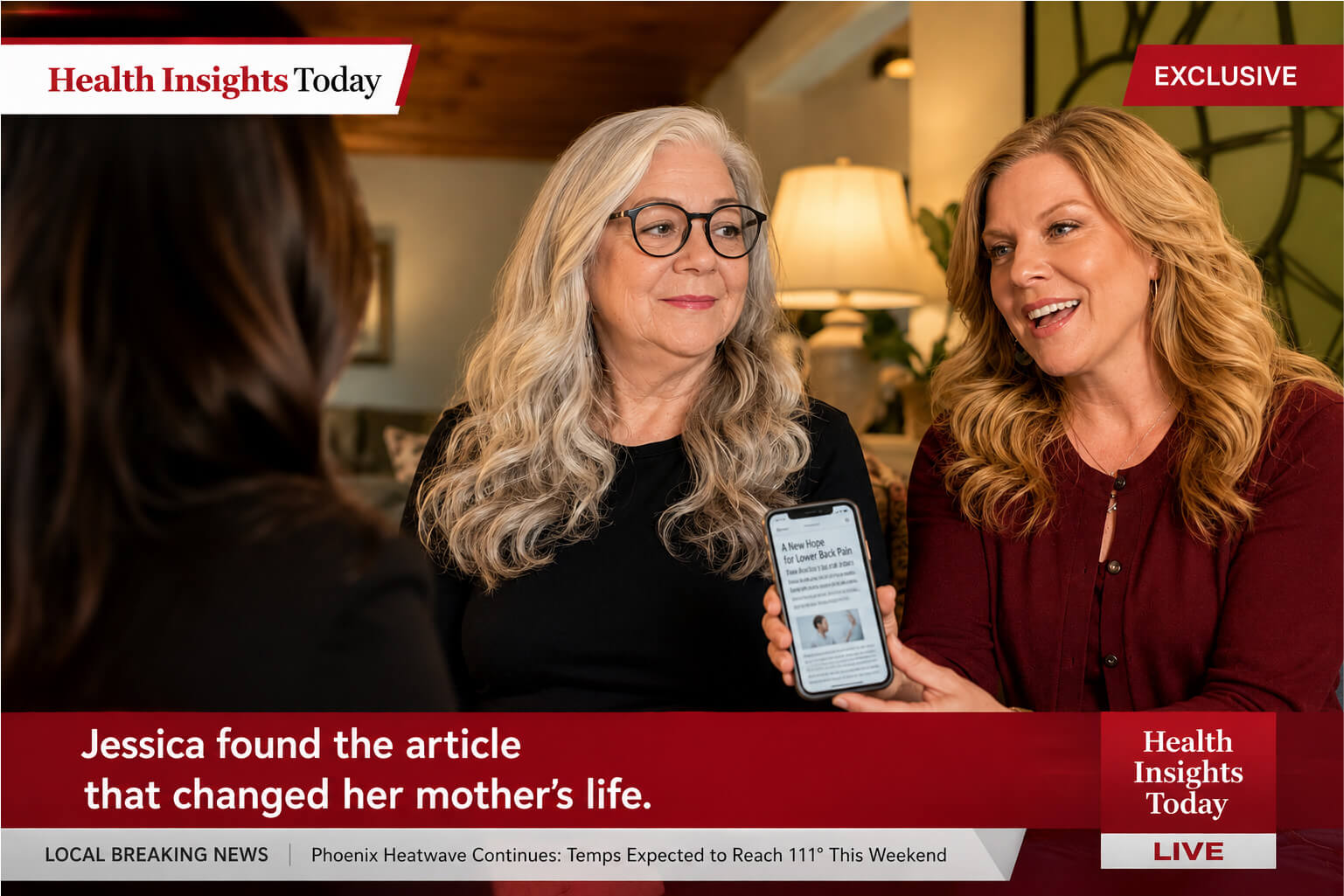
Jessica, Margaret's daughter, found the article that changed her mother's life.
It was an article about an elite medical school-trained surgeon who had reportedly given up performing surgeries to build a home device for back pain. The early reports from patients were getting national attention.
"I almost deleted it," Jessica told us. "I figured it was a scam. There's a million of these things online. But something about the article stuck with me. He'd built it because of his own father. So I called my mom and I said: Mom, this is the last thing I'm going to ask you to try. Just try this. If it doesn't work, you go ahead with the surgery. But please. Try this first."
Three weeks later, Margaret cancelled the surgery.
We had to find out how.
"Your Spine Is Going Flat." The Discovery One Surgeon Says Could Save Millions From Surgery
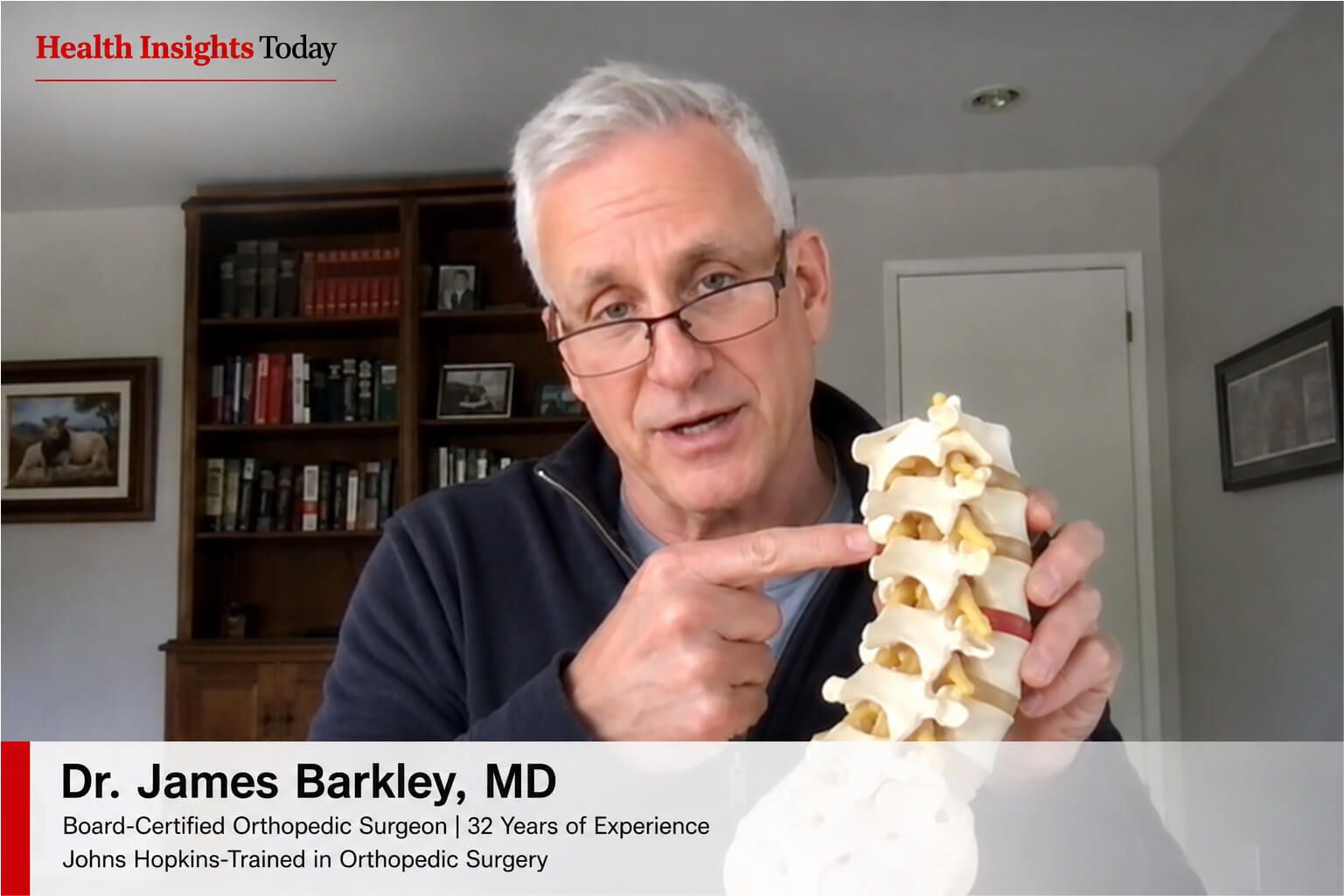
Dr. James Barkley, MD. Board-certified orthopedic surgeon. 32 years in practice.
The man behind the device is Dr. James Barkley, MD. A 61-year-old board-certified orthopedic surgeon based in the Midwest.
We reached him by phone last week. He spoke to us for nearly two hours.
"I've performed over 600 spinal surgeries. For 32 years I did exactly what every spine surgeon does. Physical therapy first, injections when PT fails, surgery when injections fail. I never questioned the order. None of us did."
What changed, he said, was watching his own father, a retired long-haul truck driver, collapse over the course of three years from a man who could still throw a baseball with his grandson into a man who couldn't sit through a child's birthday party.
"I found him on the couch at 2 AM in tears," Dr. Barkley said. "Not from the pain. From defeat. He looked at me and said 'I'm just a burden now.' And I realized I had spent my entire career performing operations that wouldn't have helped him."
That night, Dr. Barkley says, he stopped following the standard treatment playbook he had been trained on for three decades. And he started asking a different question.
His answer is what he now calls Progressive Arch Collapse. According to him, it's the structural failure that virtually every back pain treatment of the last 30 years has left completely untouched.
Dr. Barkley compares the spine to a stone arch bridge. The curve is what makes it strong. When it flattens, the structure collapses.
"Your lower back is supposed to have a natural inward curve," Dr. Barkley explained. "About 30 to 40 degrees of arch. Think of it like a stone arch bridge. The kind the Romans built that's still standing two thousand years later. The curve is what makes it strong. The curve is what creates the space underneath, where everything has to function. Your discs, your nerves, your muscles."
When that curve flattens, from decades of sitting, driving, hunching, the structure collapses, he said.
The discs get crushed. The nerves get pinched. The muscles around the spine seize up trying to hold the failing structure together.
"And here's the part nobody tells you," Dr. Barkley said. "Once the muscles seize, they pull the curve even flatter. The very muscles trying to protect you are accelerating the collapse."
"That's why every massage, every stretch, every chiropractic adjustment wears off so fast. You're trying to relax muscles that have a structural reason to keep tightening."
We asked Dr. Barkley a direct question. If this is so simple, why aren't doctors fixing it?
His answer was uncomfortable.
"There's no insurance billing code for 'restored the patient's spinal angle,'" he said. "Physical therapy treats muscles, not the curve. Steroid injections reduce swelling, not the curve. Surgery removes damaged disc material, but the flat, collapsed spine that caused the damage in the first place stays exactly the way it was when the patient walked into the operating room."
"Patients keep coming back. Treatment after treatment. Bill after bill. And the actual problem is never addressed."
He paused.
"I was part of that system for 32 years. I'm not proud of it."
The Three-Mechanism Device That Has Reportedly Helped 21,500 People
After his father's collapse, Dr. Barkley spent four months in research. He reviewed over 300 studies on spine mechanics, flew to medical conferences in Europe and Japan, and consulted biomechanics specialists at three universities.
The conclusion he reached, he says, was that lasting relief from chronic lower back pain requires three things to happen at the same time. Not one at a time, not in sequence:
- 1. Physically restore the spine's natural arch so the structure can carry weight properly again.
- 2. Rehydrate the dried-out discs with deep infrared heat that penetrates to the disc level.
- 3. Release the deep stabilizer muscles with vibration tuned to the precise frequency that unlocks them.
"Each one alone fails," Dr. Barkley said.
"Restore the curve without heat? The dried-out disc is still flat. Apply heat without restoring the curve? You're warming a compressed space. The fluid has nowhere to go. Vibration without the other two? The muscles relax for an hour and tighten right back up because the structural problem is still there."
But no commercial device on the market did all three at once.
So he built one.
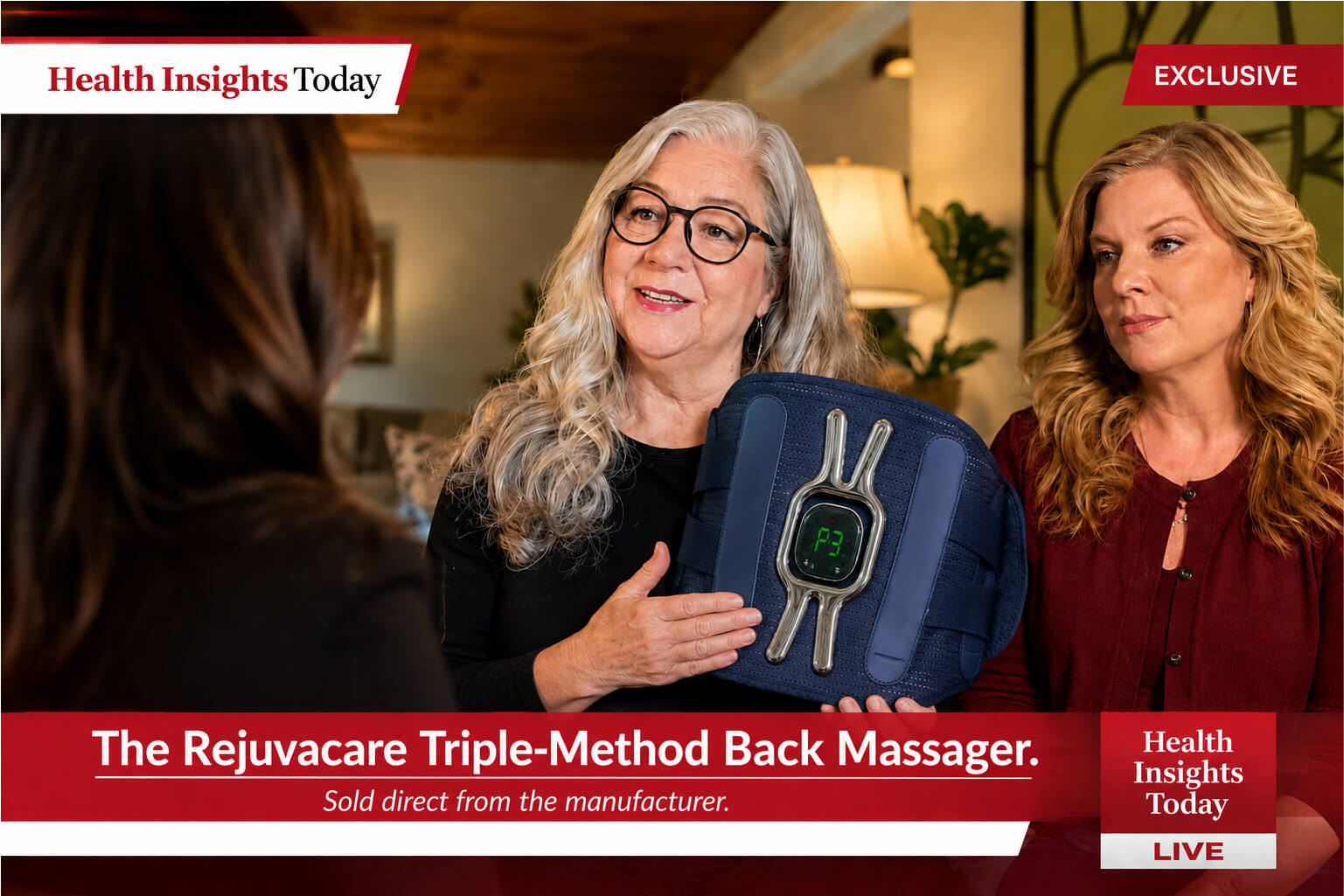
The Rejuvacare Triple-Method Back Massager. Sold direct from the manufacturer.
The result is a home unit called the Rejuvacare Triple-Method Back Massager. Designed in partnership with a biomedical engineering team that included two Ivy League-trained PhDs and a medical device specialist with 14 prior FDA clearances on his record.
According to data the company shared with us, the device has now been used by over 21,500 men and women across the United States, with internal satisfaction tracking at 99.7% (a return rate of 0.3%, or 64 returns out of 21,500 units).
We asked for the breakdown.
For users in the early stages of back pain, the company reports:
- 94% felt major pain relief within seven days
- 91% stopped taking pain medication within three weeks
- 97% did not progress to chronic back pain
For chronic pain users (Margaret's category):
- 87% reported significant or complete relief within 14 days
- 81% reduced or eliminated medications within six weeks
- 74% who had been told they needed surgery improved enough to cancel it
"That last number is the one that keeps me up at night," Dr. Barkley said. "Three out of four people who had been told they were going under the knife, at $35,000 to $95,000 a procedure, didn't need to go."
Not Everyone Is Convinced
We did our due diligence and reached out to several spine specialists outside Dr. Barkley's circle.
The reactions were mixed.
One Beverly Hills orthopedic surgeon, who asked not to be named, called the device's claims "optimistic." He noted that "no home product can replace the precision of a surgical correction in cases of severe disc herniation or stenosis."
A second specialist, a physiatrist at a major Midwestern teaching hospital, was more measured.
"The underlying biomechanics are not controversial," he said. "Restoring lordotic curve absolutely reduces compressive load on the discs and nerves. The European Spine Journal has published on this for decades."
"Whether a 15-minute home protocol can deliver clinical-grade decompression is the open question. I'd want to see independent trials."
When we put these critiques to Dr. Barkley, he didn't argue.
"They're right that we don't have a finished independent trial yet. We're in the process of arranging one. They're right that severe structural damage sometimes still requires surgery. I'm not telling people to throw out their medical care."
"I'm telling them that for the millions of people whose spines are slowly collapsing, and who are being told it's 'just their age,' there's a structural fix that nobody is offering them."
He added: "The 21,500 people using the device aren't a clinical trial. But they're real. And the 0.3% return rate isn't normal for a $99 product. People keep these. That tells me something."
What "Just Living With It" Actually Costs

Margaret's notebook tallying seventeen years of back pain treatments.
When we sat down with Margaret again, we asked her to do the math on what the past seventeen years of back pain had cost her.
She got out a notebook.
The two prior surgeries, including her insurance copays and post-op rehabilitation: roughly $31,000 out of pocket.
Steroid injections, conservatively three per year for ten years at $1,500 each before insurance: somewhere around $45,000 in pre-insurance billing, of which she estimates she paid $9,000 directly.
Physical therapy, on and off for fifteen years: another $8,000-plus in copays and out-of-network sessions.
Medications, supplements, ergonomic chairs, a $4,200 mattress, two inversion tables, a TENS unit, two custom orthotics, an aquatic therapy program: another $14,000.
And the third surgery she had been about to have? Estimated at $74,000 before insurance.
"I figured I had spent something like $62,000 of my own money trying to fix this thing," Margaret said. "And the surgery I cancelled would have brought me to nearly $90,000. For a procedure that has a 40% chance of not working."
She picked up the small device on her kitchen table.
"This was $99."
She started laughing. Then she started crying.
What Margaret's Three Weeks Actually Looked Like
We asked Margaret to walk us through her experience using the device, day by day.
"Honestly? Nothing dramatic. I lay on it for fifteen minutes a day. I felt the heat, I felt the vibration. My back felt good while I was on it, but I figured that was just the heat. I'd been using a heating pad for years. I almost gave up after three days. I'm glad I didn't."
"The first thing I noticed was the mornings. I usually wake up and it takes me about thirty minutes of moving slowly before I can do anything. By day six, I got out of bed and walked to the kitchen without bracing on the wall. I almost didn't notice I'd done it. My husband noticed before I did."
"I sat through a whole movie with my husband for the first time in I don't know how long. We watched Casablanca. I sat through the whole thing. I cried at the end of the movie, and I cried again because I had been able to sit through it."
"I bent down and picked up our cat. I hadn't picked up a cat in three years. My husband walked into the room while I was holding her and just stood there. He didn't say anything. He didn't have to."
The follow-up appointment with the surgeon: Margaret cancelled the surgery the day before her pre-op consultation. She called her surgeon's office directly. According to her, the office staff was not surprised.
"The receptionist told me they get cancellations like mine every week now. I asked her why. She said, 'Honey, a lot of people are finding things that work. Doctors don't always know what their patients are doing at home.'"
Check current availability ›
Real Users Tell Us Their Stories
We asked the company to put us in touch with other users who had agreed to be interviewed for publication. Three responded.
We were able to verify that all three are real, verified purchasers who agreed to be quoted on the record.
How the Device Actually Works
We asked Dr. Barkley to walk us through what happens to a user's spine during a 15-minute session. He provided the following breakdown.
The three phases of a 15-minute session.
Minutes 0 to 5: The spine opens.
The contoured brace gently restores the user's natural lumbar curve. Within the first 60 seconds, the vertebrae begin to separate. The space the spinal nerves pass through opens up.
Most users report what Dr. Barkley calls "the deep release." A sensation of pressure that has been building for months or years finally letting go.
Minutes 5 to 10: The discs rehydrate.
With the curve restored, far-infrared heat (calibrated to penetrate 3 to 5mm to the disc level, not just the surface skin) increases blood flow to the previously compressed disc tissue.
The discs, which have been squeezed flat from decades of compression, begin to draw fluid back in. "Like a sponge finally released from a fist," Dr. Barkley puts it.
Minutes 10 to 15: The muscles release.
Targeted vibration tuned to 30 to 50 Hz (the specific frequency range that reaches the deep stabilizer muscles, not the surface ones) signals the body's protective bracing pattern to stand down.
The seized muscles that have been pulling the spine flat for years finally let go.
After 15 minutes, the user's curve is restored, the discs are rehydrating, and the muscles have stood down.
"You repeat it daily for about three weeks," Dr. Barkley said, "and the spine starts holding the restored curve on its own. You're not managing pain anymore. You've fixed the structure that was causing it."
The Price Question
This is where, frankly, the story gets uncomfortable.
The clinical-grade spinal decompression devices found in the offices of the very surgeons who recommend the surgeries Dr. Barkley says are unnecessary cost between $2,200 and $4,000.
Patients pay per session, typically $80 to $150, and have to drive to the clinic twice a week.
The Rejuvacare Triple-Method Back Massager delivers what Dr. Barkley says is the same three-mechanism protocol. At home. On the user's schedule. With no appointments and no copays.
Standard retail price: $249.95.
But during the company's current introductory launch, which runs until they hit 5,000 units sold from this production batch, the price is $99.95.
We checked the website while writing this article. As of this morning, the company had sold 3,847 units of the 5,000-unit batch.
At their stated production pace of 500 units per week, that batch is projected to sell out within three to four weeks. After that, the price reverts to $249.95.
We asked Dr. Barkley directly why the price was so low.
"I didn't build this to maximize profit," he told us. "I built it because I watched my father lose three years of his retirement to a structural problem that had a structural solution, and nobody offered it to him."
"I want this in the hands of the truck drivers, the office workers, the nurses, the parents, and the men and women in their 60s and 70s who are quietly losing the years they spent their whole lives working toward."
He paused.
"The medical system doesn't fail people because the people in it are bad. It fails them because the system is built around procedures that can be billed, not solutions that can be done at home in 15 minutes. This is my answer to that."
The 90-Day Guarantee
Every Rejuvacare Triple-Method Back Massager ships with what the company calls a "90-Day Pain-Free Guarantee."
Users have 90 days from delivery to test the device. If they don't feel real, lasting improvement, the company refunds the full purchase price. No forms, no questions, no hassle.
We asked the company's customer service team how often they get refund requests.
The answer: 64 requests out of 21,500 units sold. A return rate of 0.3%.
For comparison, the average return rate on direct-to-consumer health and wellness products in 2025 was approximately 17%.
"I'm not betting on hope," Dr. Barkley said. "I'm betting on physics."
What Margaret Wants Other People to Know

Margaret with her grandchildren on the day of this interview. "I'm at the table again."
We asked Margaret what she would say to someone reading this article. Someone in pain. Someone scheduled for a surgery. Someone who had given up.
She thought about it for a long time.
"I would say the part that almost broke me wasn't the pain. It was the loneliness. It was being the person at the family dinner who had to keep getting up. It was being the grandmother my grandkids stopped asking to come visit. It was looking in the mirror and not knowing who that small, careful, scared woman was anymore."
She paused.
"My daughter saved my life. She wouldn't let me give up. She kept saying 'Mom, just try this one more thing.' If you have someone in your life who is suffering, a parent, a husband, a wife, please don't wait for them to ask. They've stopped asking for things. They've been asking for years and nobody listened."
"Just buy the thing. Send it to them. Let it be your version of saying 'I'm not going to let you disappear.'"
She paused again.
"And if you're the person reading this who is in pain, please. Please. The version of you that existed before the pain isn't gone. It's still in there. It's just buried under something nobody bothered to fix. You're not done. You're not finished. You're not 'just old now.' You're a structure that needs rebuilding."
"Try the rebuilding. What's left to lose?"
How To Get One
The Rejuvacare Triple-Method Back Massager is sold directly through the company's website. As of this morning, it ships free within the United States and arrives in 3 to 5 business days.
A summary of what we confirmed during our reporting:
- FDA-registered, manufactured in an ISO-certified facility
- Currently $99.95 (down from $249.95 retail) until the 5,000-unit introductory batch sells out
- 3,847 of 5,000 units sold as of this morning
- 90-day money-back guarantee, no questions asked
- 0.3% return rate across 21,500 verified purchases to date
The official website is currently the only place to purchase the device. The company has confirmed to us that they do not sell on Amazon, Walmart, or third-party retailers. A deliberate choice, Dr. Barkley says, to maintain quality control and protect the introductory pricing.
You can check current availability and order directly at the link below.
Reserve your device while the introductory price holds
Currently $99.95 (regularly $249.95) · 3,847 of 5,000 units sold · Backed by a 90-day money-back guarantee
Check Availability Now